
 Symbols that catch our attention and our emotional connection are more effective than a hundred words. For two years the yellow ribbon has become prevalent in Israel and the world over as a solidarity symbol conveying the message “Free the Hostages”. The yellow-coloured ribbon could be seen pinned to practically every person’s clothing, and not only in Israel. People the world over in Jewish communities and others wanting to identify with the call to bring the hostages home used the ribbon as well.
 This is not the first time that a symbol has been used effectively to mobilize support for a cause. The Breast Cancer campaign ribbon has been used effectively to educate the public and solicit donations for cancer research. Once a symbol is identified with a cause, there is no need for lengthy explanations. We see symbols every day in all areas of our life, and often do not even need any explanations. Take for example traffic signs. We automatically recognize the “stop” sign without the word stop, anywhere in the world. When you receive a driver’s license you need to pass a test recognizing all the traffic signs. They all adhere to the principle that a picture is worth a thousand words.
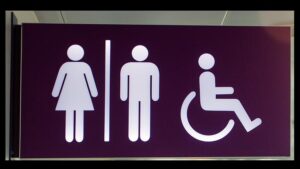 When my mother first came to visit us in Canada, she landed in JF Kennedy Airport. She approached the agent at the Air Canada counter thinking she would speak French. No such luck. She needed to go urgently to the washroom, but did not know any English. She tried German (closet), British English (water closet), and French (pissoir) – all to no avail. She was sent to the lockers! In desperation she looked up and saw the universal symbol for male and female washrooms.
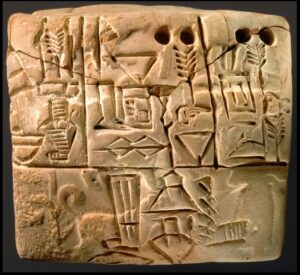 Using symbols for communication of ideas and group identification started with the use of Cuneiform, which is one of the earliest communication systems with pictographs. A bull’s head was used to represent cattle, a wheat stalk for agriculture. Initially a system of pictographs, it evolved into a logo-syllabic script used for record-keeping, literature, and administration by various cultures, including Akkadians, Babylonians, and Hittites. It was used by many different languages for almost 3000 years.
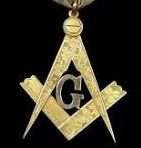 Symbols are also used to identify groups of people, by cultural or religious affiliation. The Cross symbolizes Christianity, and different forms of crosses symbolize different Christian denominations. However, the cross that symbolized Nazism came from a much older civilization and was adopted by the Nazis and neo-Nazis as their symbol of superiority, while others see it as a symbol of evil. The Magen David is recognized as a symbol of Judaism, and does not differentiate between Jewish denominations. It is used as a symbol of pride, yet was used by the Nazi regime as a symbol of humiliation. Jews were forced to wear the yellow patch with a Magen David on it in order to identify, humiliate, and target them as a population open for abuse and ridicule. Many associations adopt a symbol as a means to identify themselves, their members, and their philosophy – for example the Freemasons, youth movements, professional associations and political parties. And of course, in sports, wearing the colour of our favourite group and their symbol on our hats and other clothing. This is especially common in soccer, basketball, hockey, football and cricket. Industry pays a lot for advertising in order to establish their symbols, so that you associate them with certain foods, transportation, clothing, and anything they want you to buy and consume. Who does not recognize the symbol of Kellogg’s, McDonalds, Toyota, Mercedes, or Honda? In clothing Chanel, Louis Vuitton, Lululemon, etc. I could fill pages with their names. Perfumes, cosmetics, any product we use has a label. As fashions change, people look at the labels and buy products to belong to the “in” crowd.
 We live in a symbolic world. We belong to countries that we recognize by their flags. We proudly fly the flags during the national holidays to symbolize our identification with the country we belong to, came from, or have an affiliation with. In demonstrations one can see people covering themselves with their flag, or on the contrary, burning the flag of the people they hate. The action symbolizes love or hate. We are constantly exposed to symbols and are able to identify each other’s affiliations, thus creating contacts and establishing groups merely by recognizing a symbol. As an Art Therapist I work all the time with the symbolic meaning of drawings and creations that are the language of feelings and the soul. In situations of emotional turmoil when there are no words to express joy or anguish, the creative product expresses the symbolic meaning of feelings. The product in front of us brings to life the words that describe it and the feelings connected to it. I can thus claim that the language of our soul and our feelings is a symbolic language.
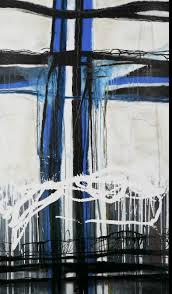 However, these symbols have a lot of individual interpretation, therefore it is wrong to interpret an artistic product. The only one who can interpret the work is the person who created it. Any other interpretation comes from our own projection.
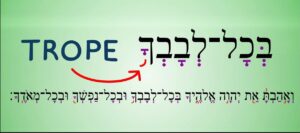 Lately I’ve been learning a new language of symbols – or rather – ancient musical notes which are called “trope” (te’amim in Hebrew), for chanting when reading from the Torah scroll, as well as a different trope for chanting the portion from the prophets which is called Haftarah. It is customary for young boys who have reached the ripe age of 13, as well as girls at the age of 12, to start their adult duties in Jewish life by learning to chant a portion from the Torah reading and the Haftarah, and to chant it in the synagogue on the Sabbath after their birthday. This is called Bar/Bat Mitzvah. When I was 12, girls were not allowed to practice this traditional custom, and instead only had a party for their classmates and their parents’ friends. Even when my daughter turned 12, and we belonged to an Orthodox synagogue, she did not have the privilege of learning the trope, and reading from the Torah and the Haftarah, but had an opportunity to address the congregation on the Sabbath with a Drasha, a speech she composed about the relevance and teachings of the Torah portion for that Sabbath. I waited a long time, loved learning scriptures and Talmud, commentary, and old stories. I participated in Jewish community life in Canada and Israel. I became more of a feminist and was not comfortable any more in a patriarchal Orthodox synagogue. Though there are Egalitarian Orthodox synagogues which I would be comfortable belonging to, there is none where I live. I joined a Conservative (Masorti in Israel) congregation in which I feel like an equal member. It took a long time until I decided that I am now mature enough to celebrate my Bat Mitzvah. This year, my Hebrew birth date falls on the same Gregorian date as in the year I was born. I am learning a new language, the trope, so that I can be called to read a part of the portion from the Torah scroll and chant the Haftarah like every 12-year-old, and have the pleasure of my loved ones and my guests showering me with candies at the end. I hope there will be some children to run around and collect the candy with smiles and joy. I assure you I am not a masochist – I bought soft jelly candies!


PS – the reader in this photo is not me; it’s just an image I found.