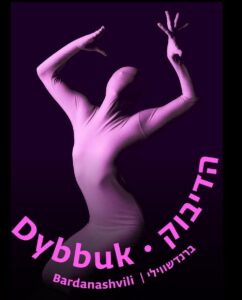
 It was a once-in-a-lifetime experience which made me thank the universe that I am still alive to experience: a world-premiere Opera production of The Dybbuk, composed by award-winning composer Josef Bardanashvili, originally from Georgia, whose music is influenced by the rich traditions of his birthplace and his Jewish heritage. The Hebrew libretto, by Ido Ricklin, is a new adaptation of the moving story of Leah and Hanan, originally written by S. An-Sky in Yiddish. It was also directed by Ricklin, who turned the mystical tale into a bold and moving psychological drama reflecting the turbulent space between tradition and progress; between forbidden love and madness. The staging was brilliant, emotionally captivating and magical. In many scenes there were two layers to the stage (upper and lower), giving a feeling of spiritual and earthly meaning to the same scene. The mainly male choir in the synagogue scenes gave an added depth to the familiar prayers known to many in the audience, and made me experience them in a new way. Leah, performed by Alla Vasilevitsky, was both a moving theatrical performance and an exquisite vocal delight. She came across as genuine and believable, totally devoid of pathos.
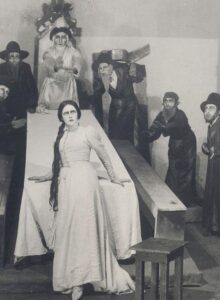 My first encounter of the Dybbuk was when I saw the legendary actress Hanna Rovina play the role of Leah at the Habima Theatre in Tel Aviv. It was sometime in the 1950s, but Hanna Rovina was the only one to play that role from the first Habima production in 1922 to the last in 1979. There was even a performance at the Nations Theater in Paris in 1957. Her performance was full of pathos, a real theatrical drama.
“The Dybbuk is the soul of someone who has died and, rather than moving on in the afterlife, that soul has lodged itself in the body of a living person,” says Chajes, author of “Between Worlds: Dybbuks, Exorcists, and Early Modern Judaism. “It’s a variation on the phenomenon of spirit possession, which exists in nearly every human culture we know of. Typically, possession is a “kidnapping or ransom phenomenon, where the Dybbuk is able to threaten the life of its host,” says Chajes. In exchange, the Dybbuk receives passage from the human world to a metaphysical one. In some cases, the rabbi successfully rids the victim of the spirit and allows the Dybbuk to move on to an afterlife, despite the sins it had committed. There is, after all, no eternal damnation in Judaism. However, in many cases as we saw in the opera and the play, the victim dies. The Dybbuk has done something terribly wrong, and the victim has to pay the price.
The Dybbuk is not necessarily a widely known supernatural figure like the demons of Catholic possessions, despite its deep historical roots. “There are all these beings described in the Talmud, and clearly not all of them are believed [in], and certainly not adhered to,” says University of Connecticut anthropologist Richard Sosis. Violent persecution during witch trials, the Inquisition, and Eastern European pogroms, as well as the proliferation of antisemitic tropes in mainstream European folklore, for example, the big-nosed, child-eating villain of Hansel and Gretel, and the rise of skepticism during the Enlightenment, all contributed to the suppression of these traditions. Indeed, for safety, many Jewish communities across the world kept their stories and customs secret.
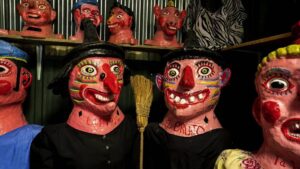 Debbie Lechtman, the author of The Witches of Escazú and Other Jewish Fairytales who grew up in Costa Rica, tells a story from her childhood relating that the ancestors of many of the Jewish people in her town migrated there during the Spanish Inquisition. Even away from Spain, they kept their traditions hidden. “The idea was that people would see Jewish women lighting the Shabbat candles through the window and think they were doing witchcraft,” she says, “and to this day, the city’s nickname is the ‘City of Witches.’ Many non-Jewish people have no idea where that comes from, but the Jewish community has passed this down.”
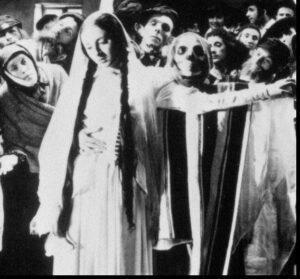 The practice and belief in the Dybbuk has mostly ended, despite its social media and Hollywood resurrection in film, and recently in another ultra-modern chamber opera in English performed by the college of performing Arts in the US, as part of the Jewish historical society (available on YouTube). Unfortunately, there is no recording of the Israeli Opera production. To my taste, there is no comparison.
Some superstitions remain, and supernatural forces are still felt in various Jewish communities. Some observant Jews in Israel continue to believe in a specific demon known as the ruach ra’ah, and Sosis argues that this spirit has continued to persist because of its association with daily hand-washing rituals. The other one I am familiar with is the tying of a red string on a newborn’s wrist and placing amulets in the room to ward off the spirit of Lilith, who kidnaps the souls of babies at night. Folk stories and superstitions can be found in many of the debates recorded in the Talmud, and are used by the rabbis to make their points in their debates over religious law. They entered our folklore and like any good folk story, were repeated in order to help establish adherence to rules of behaviour. The non-Jewish members of society who were not familiar with Jewish practices and beliefs came up with their own stories which were spread by the Church and political interests. Ideas like poisoning of the wells during the Black Plague, using a Christian child’s blood to prepare the Matzah, and similar superstitions, led to pogroms and perhaps even to the Inquisition, since the Church hoped to convert Jews to Christianity.
The growth of antisemitism today shows us that the old superstitions are alive and well. Perhaps it will lead again to old and new Jewish superstitions and intolerance. We can already see the spread of hatred and war, and feel the results of destruction. So many unnecessary deaths, the use of power instead of the power of speech and the arts, the human suffering all over the world. There are humane stories we can tell, stories of caring and compassion. Perhaps if we enact those, sing those, create together works of art and beauty, we can bring some light into the darkness of destruction. Let us start a new journey of life, a journey of care and compassion.