
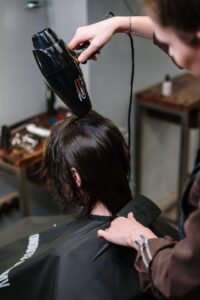
An article in Haaretz newspaper caught my attention. It talks about hair salons being re-established in Gaza. Finally an item not connected to war atrocities, casualties, or death and trauma. But funny enough it is connected to post-traumatic growth. Women who suffered two years of deprivation, uncertainty, and trauma, in a world where they had no control of anything that happens to them, are finally taking some action. They are starting to take care of themselves. By taking care of their appearance, they are taking back their dignity, their ability to control something in their life. What woman does not feel good having her hair washed & cut, her face made up, her nails painted, and able to look again in the mirror feeling younger and beautiful no matter what age she is?
 I remember my grandmother at the ripe age of 86, when she lived with me in the same room, grooming herself every morning. Even when she was wearing a simple housecoat, she made sure that her hair was done, her face clean, and her lipstick on, before she left the room to prepare her breakfast (she also took a swig of slivovitz from a bottle hidden in the cupboard). It made her feel presentable. It made her feel beautiful, which she was.
Self-care and compassion go hand in hand. Self-care is indeed compassion for yourself, but it also promotes compassion for others. Balancing compassion for self and others can be a tricky — but a crucial process. In his 2025 book, From Self-Care to We-Care: The New Science of Mindful Boundaries, Dr. Quaglia introduces a science-backed approach to interpersonal dynamics. Key principles of his practice include: self-compassion and compassion for others which are already intertwined at the level of the nervous system. He calls this combination of self compasion and compassion for others WE-CARE. From this perspective, healthy boundaries come from flexibly emphasizing care where it’s most needed, rather than polarizing it. In the traumatic situation of war or conflict, the boundaries are not clear, and often polarized: either total care for others, forgetting yourself, or the other way around. Therefore, the example of the hair-salon owner is a perfect one to create a balance and healthy boundaries both for the hairdresser and the customer.
 Boundaries are connected both to self, partners, strangers, and political entities. When we learn to respect our own boundaries, we are able to respect the boundaries of our loved ones, family members, work colleagues, strangers, and social norms. Each culture carries within it specific norms and boundaries. When those are flexible, it is comfortable to exist within that society. When the norms are too rigid, the individual can no longer live comfortably and care for others. There is no longer We-Care, and the balance is shattered. Similarly, when a society ceases to respect another society or country’s boundaries or borders, and invades them, there is no longer a possibility for a we-care of mutual respect and mindful boundaries. In order to get back to the desired balance, it must start from the individual self care and self respect, working on creating mindful boundaries for self. Thus, self-care is a crucial component in post-traumatic growth, of both an individual and a society.
 Writing about self care and looking at myself in the mirror, I realized I badly need a haircut. I have been neglecting myself for too long. There is a handy hair salon at the shopping centre close to my home so I rushed over, and found the hair dresser as if she was waiting for me. Her smile and invitation felt so nice that I told her to do whatever she thinks would suit me. I could see she enjoyed the trust, and I enjoyed her full attention. Letting someone wash your hair, carefully attending to you, making sure you do not get wet, that your hair is well tended to, that you are enjoying the process, made me totally relaxed. When she was finished, she looked at her handiwork and pronounced “like a queen”. We had a perfect We-Care moment of interpersonal dynamic, just as the women in Gaza experienced when they finally had an opportunity to care for themselves, and have someone care for them.
The importance of self-care is emphasized not only for trauma survivors, but especially for professional mental-health therapists, social workers, front-line disaster workers and anyone who is caring for others. The principle of putting on your own oxygen mask before you help a minor on an airplane holds for all professionals who are responsible for others. It makes perfect sense that if we do not care for ourselves, our resources for caring for others will be depleted. In a recent lecture about helping survivors of the Nova festival, I was pleased to hear that the first thing on the agenda is one of the best practices one can do to calm down and relax – BREATHE. Deep breathing through the nose, expanding your belly, and exhaling fully through your mouth. I call it 7/11 – for those familiar with the convenience store, it’s not that. It is counting to 7 while inhaling, and to 11 while exhaling. The scientific explanation is that the longer exhalation brings down cortisol, which is the stress hormone, by increasing oxytocin, the love hormone. This is a natural way to decrease cortisol, and thus stress. The other effective self-care strategy is movement, and I was pleased to hear that Qigong is one of the most effective exercises for self-help and health. This is something I found out about many years ago, and practice regularly. Anyone who is not familiar with this ancient Chinese body and mind practice can find many websites to get familiar with the practice, and online classes to join if you do not have a practitioner in your area.
It looks like the ancient Greeks already knew the formula: a healthy mind in a healthy body. Our scientific research only recently found the the basis for following this wisdom.